
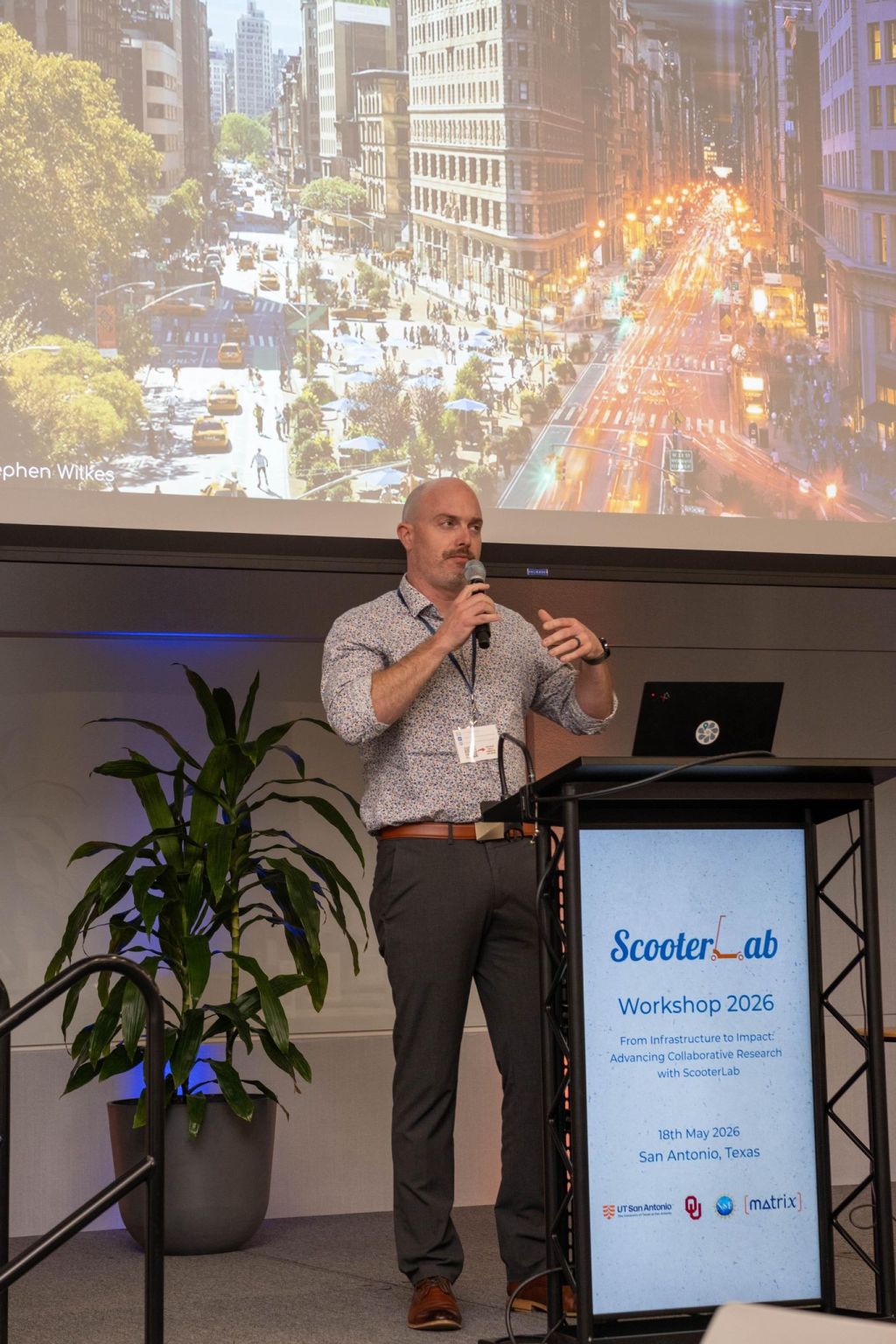
On May 18th, Prof. Grant McKenzie travelled to San Antonio, Texas to participate in the 2nd annual ScooterLab Workshop hosted at UT San Antonio. The full-day event brought together academic researchers, industry professionals, policymakers, and students working at the intersection of urban mobility, smart city infrastructure, and environmental sensing.
ScooterLab is an NSF-funded community research testbed that deploys a fleet of sensor-equipped e-scooters as an open-access platform for micromobility research. This year’s workshop, From Infrastructure to Impact: Advancing Collaborative Research with ScooterLab, built on the inaugural 2025 event by shifting focus from platform demonstration to active research execution, with sessions highlighting ongoing collaborations and shaping the next wave of deployable studies.
Prof. McKenzie delivered a keynote titled “Charged Cities: Access and Equity in the Age of Electric Micromobility”, drawing on work from the Platial Analysis Lab to explore how large-scale mobility datasets can help us understand the uneven geographies of e-micromobility access across different socio-demographic groups. The talk touched on new methods for measuring urban vitality, connections to the 15-minute city concept, and how spatial analysis and behavioural geodata can inform more inclusive, human-centreed city design.
The workshop program also featured a keynote on V2X communication for vulnerable road user safety, research talks on AI-powered mobility analytics and accessible path mapping, and a closing panel on bridging research and practice with mobile urban sensing.
It was a fantastic day of discussion and collaboration, and we look forward to working with the ScooterLab team and the broader community on future research.